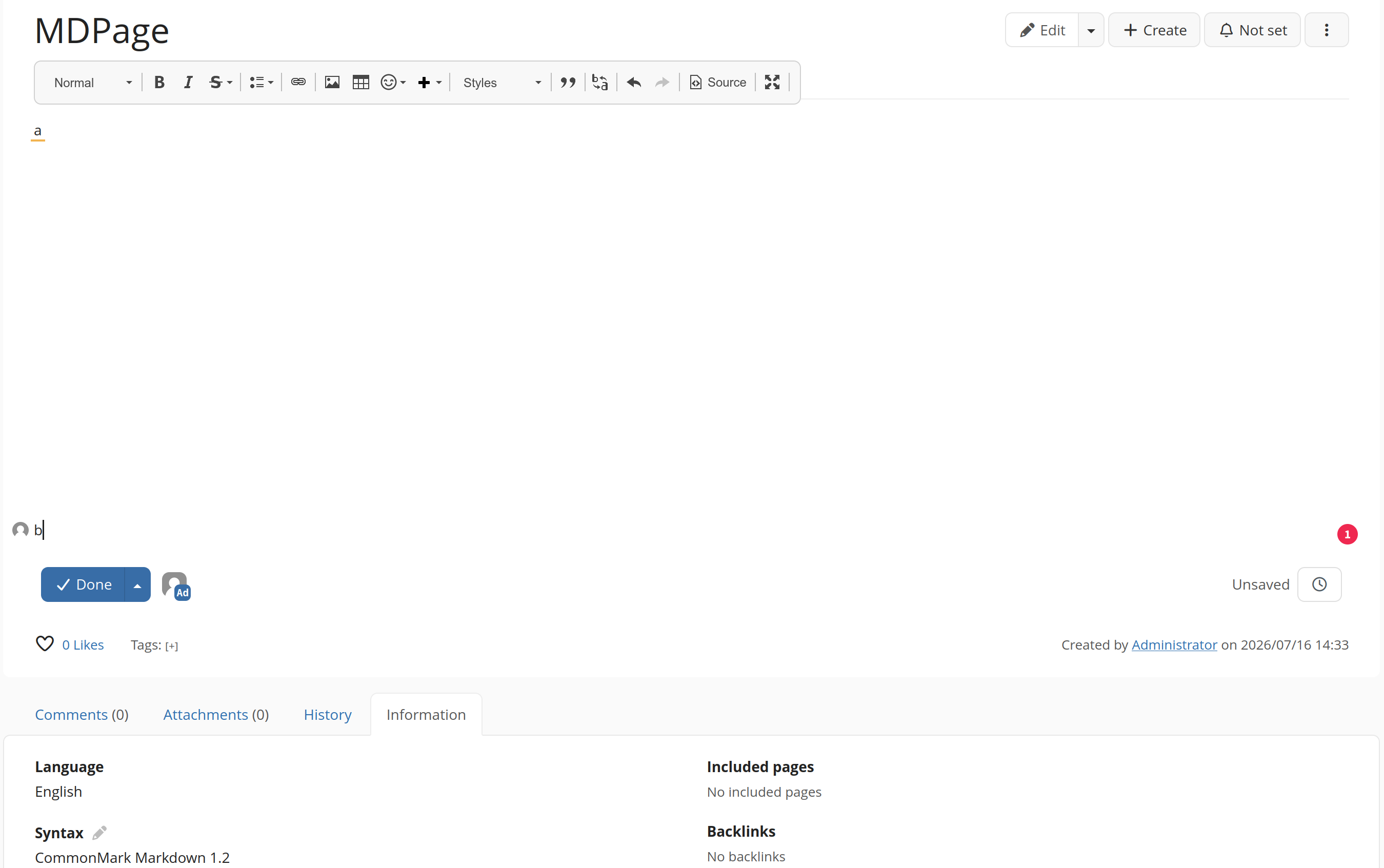
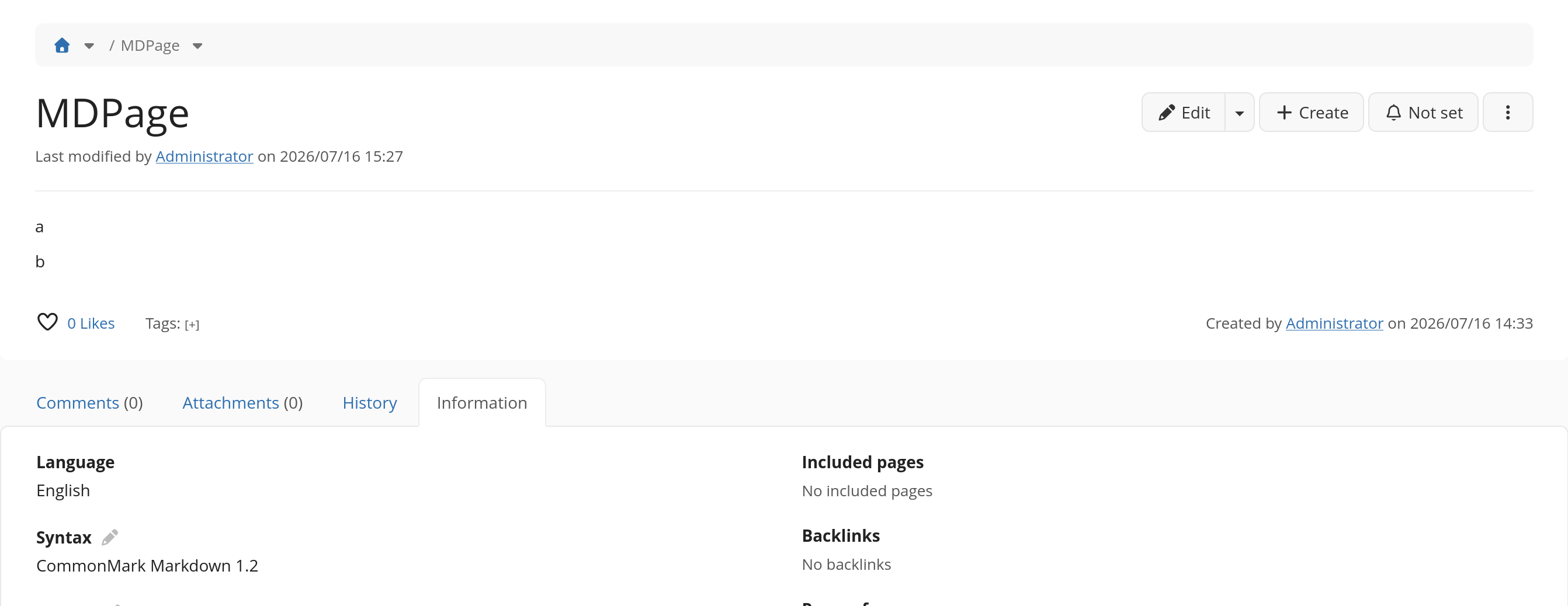
To explain the problem quickly, a user edit a page and adds a dozen lines between two paragraphs, then save.
The user expects the large gap between two paragraphs to be persisted. But, it is currently not the case and the gap between the two paragraphs is simply the standard spacing between two paragraphs.
In technical term, this is explained easily. Markdown specific that “Multiple blank lines between paragraphs have no effect” (CommonMark Spec).
But, on the other hand, this is a not aligned with the notion of WYSIWYG. The user did the intentional choice of adding a large gap and this was reflecting in its editing experience.
As it can impact some decisions, the technical scope includes:
The external sources where the markdown can be viewed through other viewers and editors. I’m mainly thinking of Cristal’s backends such as Nextcloud, Github, etc.
Also, not that the XWiki syntax support larger gap and intermediate empty paragraphs (<div class="wikimodel-emptyline"></div> when rendered in HTML).
Option 1 - do nothing
We consider that the possibility to add spaces between paragraphs is giving too much formatting control to users and that this shouldn’t be persisted.
Cons:
Not WYSIWYG
Contradict what’s done with xwiki/2.1
Pros:
Easy as there is nothing to do (close CRISTALNC-37 as won’t fix)
Option 2 - restrict the editor
Restrict the editor and disallow adding several empty lines in a row
Pros:
WYSIWYG
Cons:
Not sure about the feasibility
Option 3 - become blank lines aware
Pros:
I expect this to be an easy parser/serializer change
WYSIWYG
Cons:
Not necessarily supported by all backends, but I think this is acceptable, but there is a risk that editing the markdown with another editor removes the blank lines
Option 4 - explicitly mark blank lines
Use an explicit separator to mark blank lines (e.g., or <br />)/.
For instance:
A


B
Pros: Same as 3 - easy implementation + WYSIWYG
Cons:
Probably better support for other backends. Except if the separator is not handled, which is a reasonable risk. We can also make the separator configurable based on the backend if needed.
Conclusion
+1 for option 4 as it feels the most aligned with what we already have.
Note that the XWiki Markdown extension supports blank lines. And we cannot not have it since it’s part of our XDOM spec (and CTS). We could have a different impl in Cristal Standalone and XWiki but that’s not a good idea, so +1 to support empty new lines in Cristal standalone too.
Regarding how it’s implemented, idk. From a user POV, it’s some internal details. What’s important is that a round trip works (and no empty lines). So I guess that’s 3 or 4.
I was pretty sure I had implemented it. I also checked jira and didn’t see an open issue for it.
So it means we have a bug/limitation right now with that extension because if you convert some xwiki/2.1 syntax into markdown/1.2, we’re going to loose empty lines and that’s not good. We need to fix that eventually.
Yes, I did not develop too much on the implementation details before an option is validated.
But since option 3/4 seems to be considered, the implementation impact both mentioned parsers and serializers:
You definitely can have more than 1 empty lines with wysiwyg editor. Our users do this often. (I’m not a big fan of it.) I prefer a macro creating a div that is only styling a gap.
What ever you decide don’t use something like  . This is bad for accessibility and you won’t get bitv (german wcag) approved.
Thanks, that’s really good to know!
Note that even if those blanks lines are serialized as in Markdown, they will be presented as <div class="wikimodel-emptyline"></div> when rendered as HTML in a page inside XWiki.
But this might not be true for other platforms, so I’ll keep that in mind.
I think the first step is to add support for empty lines at AST level. XDOM (server-side) already supports this. We probably need to add support for empty line in UniAst (client-side).
Finally, we need to render empty lines from the AST to the target syntax (e.g. Markdown). This depends very much on target syntax, and whether that syntax can represent somehow empty lines. XWiki syntax supports this (and empty lines generated from BlockNote are currently preserved).
It’s not clear for me the difference between option 3 and 4. How do you represent empty lines with option 3? By inventing a dedicated syntax for empty lines (i.e. a Markdown extension)? I’m not fond of this. I’m more in favor of using standard Markdown syntax.
The thing is, there is no Markdown standard to represent empty lines between paragraphs.
Option 3: make our Markdown parsers blank space aware (we just have to make sure to persist these blank lines when serializing).
Option 4: same but we use a dedicate HTML element (this is relatively standard, many Markdown implementation support HTML elements)
For us, they are almost equivalent. The main difference is when we start considering the possibility for the markdown files to be view and edited outside Cristal, which can happen easily when Cristal is installed as a Nextcloud extension for instance.